NGC2403

Date: February 02, 2026

M106

Date: March 15, 2026

Name: Messier 106. (NGC4258)

Constellation: Canes Venatici

Distance from Earth: ~25,000,000 ly.

Capture Details: This image comprises of ~4 hours of lights, (120 frames @ 120 seconds each) using an IR-Cut filter, and processed via pixinsight.

Fun facts: I have added a second image that is Annotated, note that there are an  additional 7  NGC objects, (galaxies) hat are named plus a veritable boatload of others that are not. 

M104

Date: April 11, 2026

Name: Messier 104. (Sombrero Galaxy)

Constellation: Virgo

Distance from Earth: ~28,000,000 ly.

Capture Details: This image comprises of ~3 hours of lights, (120 frames @ 120 seconds each) using and processed via pixinsight.

Fun facts: This is my first image using my new ZWO ASI2600 MC P25 colour camera. M104 is very low in the southern sky with a maximum altitude of ~35 degrees. I normally do not image anything below 45 degrees, however at times there are no options.

M51

Date: April 23, 2026

Name: Messier 51. (Whirlpool Galaxy)

Constellation: Canes Venatici

Distance from Earth: ~31,000,000 ly. 

Capture Details: This image comprises of ~10 hours of lights, (120 frames @ 120 seconds each) using and processed via pixinsight.

Fun facts: The trailing tail in this image is called M51A or NGC5195.

M101

Date: April 27, 2026

Name: Messier 101. (Pinwheel Galaxy)

Constellation: Ursa Major, (The Big Dipper)

Distance from Earth: ~25,000,000 ly. 

Capture Details: This image comprises of ~10 hours of lights, (120 frames @ 120 seconds each) using and processed via pixinsight.

Fun facts: This is an easy binocular object, follow the handle of the Big Dipper to Alkaid, (the last star in the handle) M101 is located ~3 degrees  away.  Helpful hint:  Draw a line using  the second star, (Mizar) and the third star, (Alioth). 

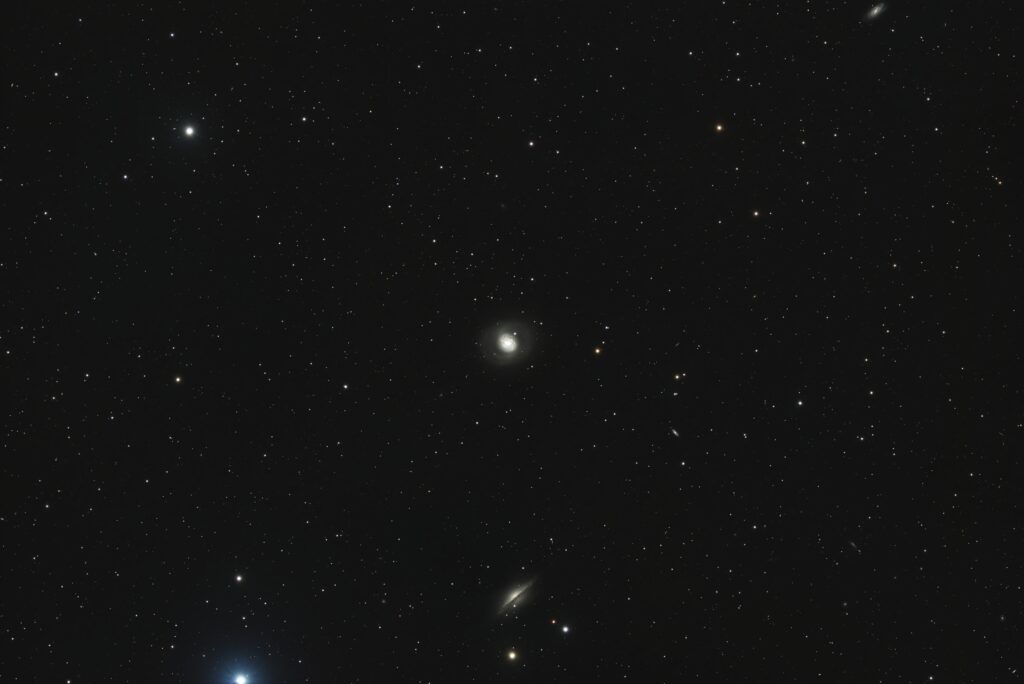
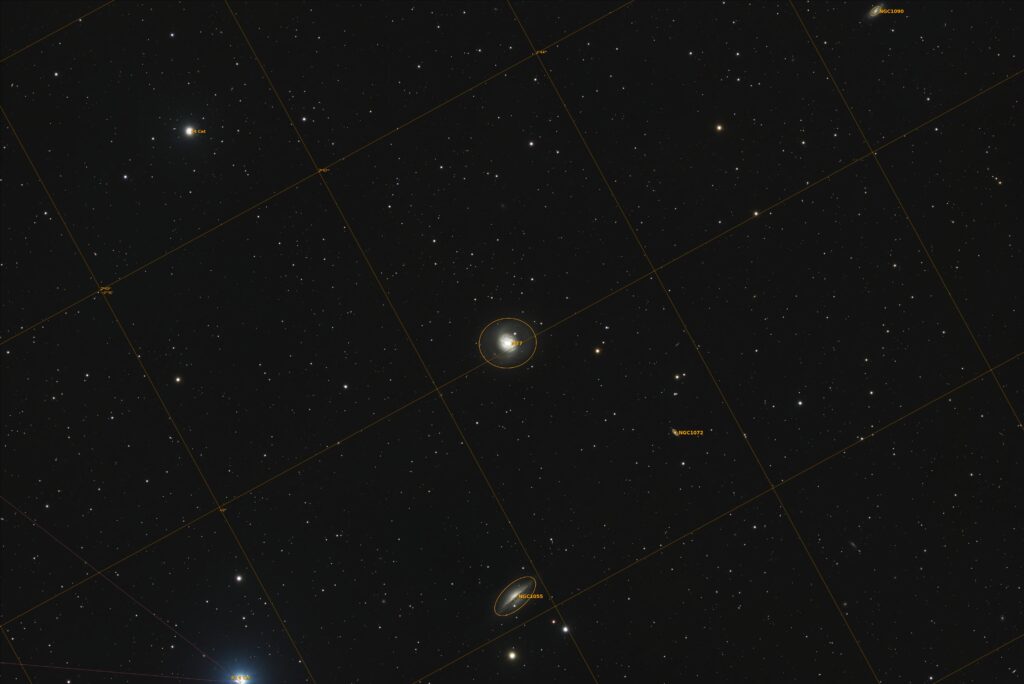
M77

Date: August 22, 2026

Name: M77 or NGC 1068, (the Squid Galaxy)

Constellation: Cetus

Distance from Earth: ~35,000,000 ly. 


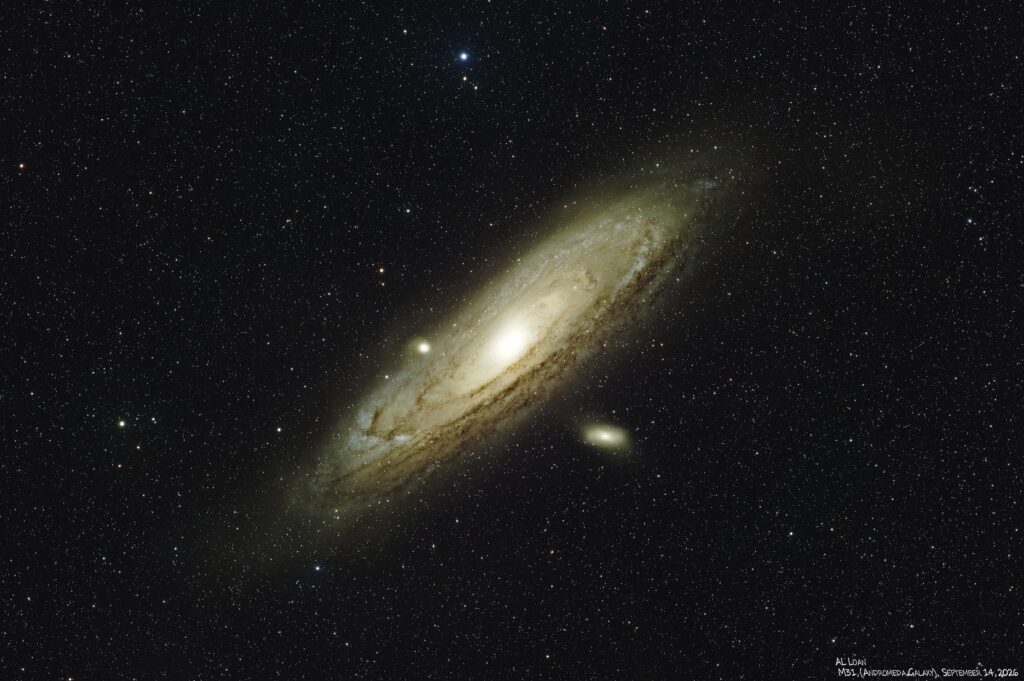
M31

Date: September 14, 2026

Name: Andromeda Galaxy (Messier 31),

Constellation: Andromeda

Distance from Earth: ~2,5,000,000 ly. 

Capture Details:

  • Telescope: William Optics RedCat 71 WIFD
  • Camera: ZWO ASI2400MC Pro
  • Filters: IR-Cut
  • Integration: ~8 hours total (~1,000 x 30s subs) gathered over three nights (September 6th, 11th and the 14th)
  • Software: Calibrated, stacked, and processed in PixInsight

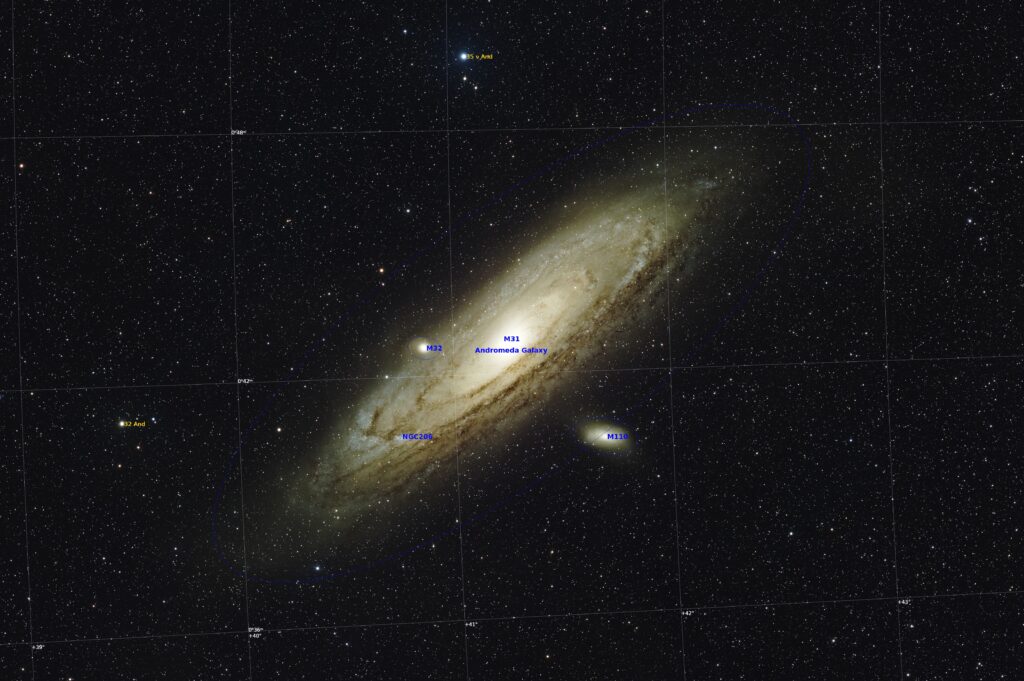
At a distance of 2.5 million light-years away from Earth it is our nearest major galactic neighbor. I have also included an annotated version for reference to help highlight the different objects in the frame.

Packed with over one trillion stars, M31 is the largest galaxy in our Local Group. This wide view beautifully showcases its expansive spiral arms, dark lanes of space dust, and bright center. Right next to the main galaxy, you can also spot its two smaller satellite galaxies: the small, packed ball of stars called Messier 32 and the more elongated, fainter one called Messier 110.

Fun fact A Cosmic Collision Course: Andromeda is screaming toward the Milky Way at roughly 110 kilometers per second. In about 4.5 billion years, our two galaxies will collide and will likely merge to form a brand new, giant elliptical galaxy.